Thursday, June 28, 2012

Introduction
19 April 2012


Hello everybody. We are Bradley, Jasmine and Majid and we are working with Zamorano University to design a process for making large quantities of BioChar. BioChar is the result of burning highly compressed agricultural waste under low oxygen conditions in a process known as gasification. It resembles Kingsford charcoal briquettes in size, appearance and density. Farmers can potentially use it as a soil additive to trap nutrients needed by crops or it can be burned like regular charcoal to cook food or produce high temperature heating. However, to understand if BioChar can excel at either of these uses, many different manufacturing processes and agricultural waste mixtures need to be tested out. This is where our UC Davis D-Lab team comes in. Over the next ten weeks, we will be designing processes and machines to grind up agricultural wasted into fine particles and compress them into a dense mass ideal for the gasification process. This will help Zamorano University thorougly test BioChar and determine whether it is a suitable product for farmers. In the future, they can use our initial designs as a prototype for a machine that will help farmers produce their own BioChar. As Professor Tim Longwell, our mentor from Zamorano University explained, "BioChar is an excellent product that can be used to increase cation exchange capacity in soils to increase yields."

The Grass Hits the Fan
2 May 2012
Today, we foraged for switchgrass, pine needles and blenders, scouring places like the Plant and Environmental Sciences garden and local thrift stores in our search. Specifically, we were looking for materials to test out our earliest design concepts. Our ideas though still vague, consisted of using a shredder or blender to reduce the grass to small particles. For compression, a car jack or hand press may work.
The first to be tested was the shredder. Shredders can cut paper into nice small squares so by the transitive property, they can cut up grass too, right? Right. We put the first batch of grass in, foolishly circumventing the shredder's many safety features, and stuffed it down with a lab notebook. We watched as the grass disappeared behind the blades. Nothing seemed to be coming out of the other end and the room began to fill with the aroma of freshly cut grass and smoke from the burnt out shredder motor.
The blender fared rather well by comparison. We shoved a fistful of grass into the glass bowl, clamped down the lid and put it on the highest speed. Eventually, a fine powder formed at the bottom of the bowl. Large pieces of grass still remained at the top, but that didn't dampen our spirits. This idea could work. Brad was also successful in destroying all evidence that he had put grass in his wife's blender.

Shopping
8 May 2012
Today is our first build session. By now, we've narrowed down our ideas to a blender to grind up the grass into particles and an extruder to compress it (check out Wikipedia for details on how the extruder works and what it looks like). We need to test different blender designs to reduce the size of the final grass particles and we have not tested an extruder of any kind yet. We decide to head over to ACE Hardware to get some materials to build and test out the ideas. The blenders at ACE are somewhat disappointing: most of the blades are fastened with rivets. This means we can't easily remove the blade and attach our own.
Target has over 15 different models of blender including the accurately named Oster Glass Jar Blender (TM, R) and the not-so-accurately named Ninja Personal Blender (TM, R). Unfortunately all of the designs suffered from the same problems as the ones at ACE: improbably strange blade mountings. We finally come to the conclusion that it would be best to build our own blender so that we can test multiple blade designs. We end up purchasing a plastic cylindrical trash can to be the blender bowl, some sheet metal to make blades from, and a meat grinder (essentially an extruder for ground beef).

We don't need no false control
10 May 2012
We begin to fashion blades from the sheet metal, but don't finish anything in time to test. The testing of the meat grinder, however, progressed much more rapidly. We chopped up some grass with a blender, lubricated it with water and stuffed it into the meat grinder. We started to turn the crank, but at some point we must have applied too much force to the handle because it broke off.
The question now is what to do with the remains of the meat grinder? Do we cleanse all traces of grass from it and discreetly try to return it to Ace Hardware, making no mention of our disregard for its intended use? Do we repair it and try to make ground beef? Or maybe we could make a modern art sculpture out of it?

Extrudinary Success!
17 May 2012
It worked! Garry from the Thailand Coolbox project loaned us his oil press (an extruder for squeezing oil out of peanuts and sunflower seeds). It successfully compressed the grass into a mass so dense its gravitational field could be measured by a fat man on a scale in Switzerland. Errr, I mean, so dense, we couldn't get it out of the die. It looks like the extruder will be our choice for compression

Wednesday, May 2, 2012

D-Lab Skills Workshop - 2012

For the first time ever, D-Lab offered a skills workshop and students learned to drill, braze, weld, build frames, sharpen drill bits and most importantly had fun!

Friday, July 8, 2011

CoolBot Project Updates

The DLab CoolBot Group decided to address the most pressing problem for the Uganda CoolBot Coolroom project, that of the large up-front cost of a solar array, by seeking to maximize the efficiency of the insulation used between the double brick walls of the coolroom in Uganda.

Financially, the cost of the system would decrease dramatically if the demand for electricity can be decreased. Thanks to the HOMER model of this particular building and photovoltaic system as developed by D-Lab I, the R-value of the insulation used relates directly to the electric load of the system. A high R-value, or more effective the insulation, will require the air conditioning unit (which cools the room) to run less frequently, using less electricity.

The five-farmer group in Yabiavoko village, Arua District in Uganda are planning to insulate the building with dry grass, stuffed into polystyrene bags. In order to determine the effectiveness of this and other insulation materials available locally in Uganda, the DLab CoolBot Group, in collaboration with Reach Your Destiny Consult, focused on building a device capable of determining the R-value of various insulation materials in the field. As requested, they also researched possible roof designs for a round structure that is fire retardant, minimizes cost and provides adequate insulation.

Here is a two minute video summary about the project.


Insulation-testing Device Design Considerations:
  • Portability: Test must fit inside a carry-on bag, with dimensions less than 22”x16”x8”, and weigh less than 26lbs. Does not require grid electricity, and provides results in under one hour.
  • Effective Comparative Test: The calibrated model must provide results within 10% of literature value.
  • Accurate in Variable Weather: Effective test when carried out in high humidity, direct sunlight, and wind.
  • Affordable: Total cost of device must be less than $50.00
The basic design constraints/metrics:
The goal was to determine the R-value of various insulation materials under local conditions. Bay measuring the time it takes the inside of a box to reach a constant temperature, given that it is split by an insulation material (can vary) and one side of the box can be heated to a known temperature.

What was learned from the prototypes:
                                                                                      Second Prototype
The D-Lab team measured effectiveness over time (rate at which temperature stabilizes) with a picologger temperature sensor, using two different box designs (see pictures). The “hot box” uses sodium acetate packets as a phase-change material to create a temperature difference between two compartments, divided by the insulation material to be tested. The “glass tube” is heated by a thermocouple wire, connected to a power source in the lab (possibly a battery in the field). Temperature sensors on both sides of the insulation material quantified heat transfer.

Project Results:
  • Hot Box Prototype: the sodium acetate hot/cold packs are a reliable source of temperature, but dimensions of box must take air currents and the insulation of air into consideration
  • Glass Tube Prototype: determined validity of procedure and appropriate thermocouple wire resistance/voltage necessary for heat generation.
  • Next Steps: build working models of prototypes, meeting design criteria. Bring to Uganda for use by Arua district farmers, and collect feedback from end-users for further improvement.
Roof Design
                                                                     
Criteria and Metrics:                                             Demonstration Coolroom
  • Affordable: Total cost less than $250.00
  • Fits local needs: Round roof design that prevents water from entering structure during heavy rain.
Recommendations:

Recommendation 1:
◦ Square ceiling on top of the existing round structure.
◦ 2-3 ft knee wall on one side to catch rafters.
◦ Ample room for insulation between ceiling joists and rafters.                                                                                                                                                      

 
Recommendation 2:
◦ Build a circular ceiling
◦ Progressively narrow the brick wall, igloo-style to seal off the roof.
◦ Ample room for insulation between ceiling and igloo-style brick roof.

Friday, July 1, 2011

Solar Fruit Drying Project

Solar fruit drying is becoming an attractive technology for small farmers in the developing world.  Its low upfront cost, zero electricity requirements and simplicity make it an easy way for farmers to avoid post harvest losses and increase profits.  As part of the 2011 D-lab 2 group, Dominic La Marche, Marco Pritoni, and Blake Ringeisen were asked if reflecting the sun’s energy onto the dryers using some kind of solar concentration device could potentially improve the performance of these solar fruit dryers in the African nation of Tanzania, where hazy and cloudy conditions frequently disrupt the drying process.

Motivation for Solar Drying in Tanzania 

Fresh tomatoes in Tanzania sell for approximately $0.13 per kg in the high season and $0.50 per kg in the low season. Dried tomatoes are generally $3 per kg, but are only one-tenth the weight of a fresh tomato.  Tomatoes can be a very large source of income for rural farmers in Tanzania, who make $200-$400 per year on average. However, due to drastic price instability in Tanzania, many crops are often left to rot in the fields when the market price drops.  Additionally, in developing countries, post harvest losses of fruits and vegetables generally range from 20-50%.  Being able to dry and preserve tomatoes during the high season and delay their sale until the more valuable low season could add a significant amount to farmers’ incomes.

Take an average Tanzanian farmer on a ¼ hectare plot of land producing 1000 kg of tomatoes and earning $300 annually. In an attempt to reduce post-harvest losses, he decides to dry 350 kg during the high season which produce 35 kg of dried fruit. Several months later during the low season, he sells the dried fruit at $3 per kg.  This produces an additional $105, which is a 35% increase in the farmer’s income.

Why it is so difficult to dry tomatoes in hazy conditions?

Well, everyone can probably imagine the reason; there is little sun out there to remove the moisture from the fruit. But what are the factors influencing the drying process? Drying is a complicated process and it depends upon many factors such as: type of tomatoes, maturity, percent of moisture, humidity and temperature of the air, and solar radiation, but also the convective effect of the air, radiative exchange with the sky and the surroundings.

How can we improve the drying rate in these conditions?

D-Lab team tried to address the problem using solar concentrators. They built two identical dryers and they tested them with various concentrators, measuring temperature and relative humidity inside the dryer, air speed, irradiance inside the dryer, as well as ambient weather conditions. These variables will be used to interpret the drying time and to guide potential improvements of the system.

With two similar dryers built and calibrated, the team was able to test their concentrator design against a control.  One dryer was set up with a prototype solar concentration; the other was set up without one.  Data such as temperature, relative humidity and solar radiation were taken at multiple locations in each of the dryers and outside in ambient conditions.

Preliminary results were encouraging so the group decided to test a larger size concentrator.The team constructed a replica of the first concentrator nearly doubled in size as their second prototype. Results were not as encouraging; It could be that other geometric factors are more important than size. They decided to try a completely different design.
 

The third design was to use concentrated sunlight to increase the temperature of an elevated black pipe to induce airflow through the dryer.The designs were all simultaneously tested against a control dryer with no concentration device. The DLab team is continuing to iterate their designs and experiment with new ones.


Work will continue throughout the summer and after some additional testing and modeling, they will hopefully be able to determine a viable solution to the problem of solar fruit drying in hazy conditions. They will continue testing these dryers during the summer while working on a mathematical model of the process. To watch the team in action, check out the video.

Wednesday, June 8, 2011

Getting more out of the India Microgrid

More than 300 million people in rural communities in India have no access to electricity—greater than the entire U.S. population. In winter 2011 Value Development Initiatives (VDI), in collaboration with D-Lab, began phase one of a solar microgrid project: designing and installing a 40-home microgrid in a rural Indian village. However, the system is far from optimal—little testing was done on the LED units before deployment, so more efficient devices may be available. In addition, the current system is unable to meet demand for a service perhaps as large as lighting itself in off grid communities—mobile phone charging.

A small centralized charging system has already been added to the system, but only has the capacity to charge 10 phones per day—far less than the number of phones in the village—and  risks long term damage to the grid’s batteries. In-home charging, however, would free people from constant trips to other towns to charge their phones, and could potentially be much more profitable. The amount of power supplied to each house is miniscule—1.5 watts for 6 hours a day. By further optimizing the voltage supplied to the LEDs, we were able to design a circuit which can charge a cell phone in less than 6 hours while keeping one LED on, and provides an additional LED when a cell phone is not being charged—all using same power as the current design. The additional up front cost of this upgrade is estimated to be about $6 when deployed in volume. We estimate an extra $1.50 could be charged per month for this service, making the payback period about 4 months.

As a further improvement, VDI was interested in whether there were LED units on the market that were a better fit for the system. To answer this question, we quantitatively tested five LED units available in India for brightness (lux) and efficacy, then performed qualitative user testing, including evaluation of light color, and usefulness for reading and tasks. Our initial results showed that using the current LED, adding a third module in series resulted in a lower overall power draw and significantly increase light output.

       Furthermore, results showed that one LED model (LBMNW4)drew 1/3 the power of the installed LED and cost 1/3 the;price, yet users showed no preference between the two. This could potentially allow for significant cost savings by reducing the size of the solar panel and batteries, or by allowing as many as 9 LEDs per house, including 3 during cell phone charging. Here is a two minute video that gives you an idea about the project.

Thursday, May 26, 2011

CoolBot CoolRoom: The Solar Array Construction

CoolBot group members Mike and
Daniel with faculty collaborator
and D-Lab instructor

 Henceforth known as the D-Lab CoolBot group, Ariana Rundquist, Daniel Sheeter, Wu Jingyan (Dora), and Michael Cunningham decided to address the most pressing problem for the Uganda CoolBot Coolroom project: the large up-front cost of a solar array. 


 Mike Cunningham working
on inverter
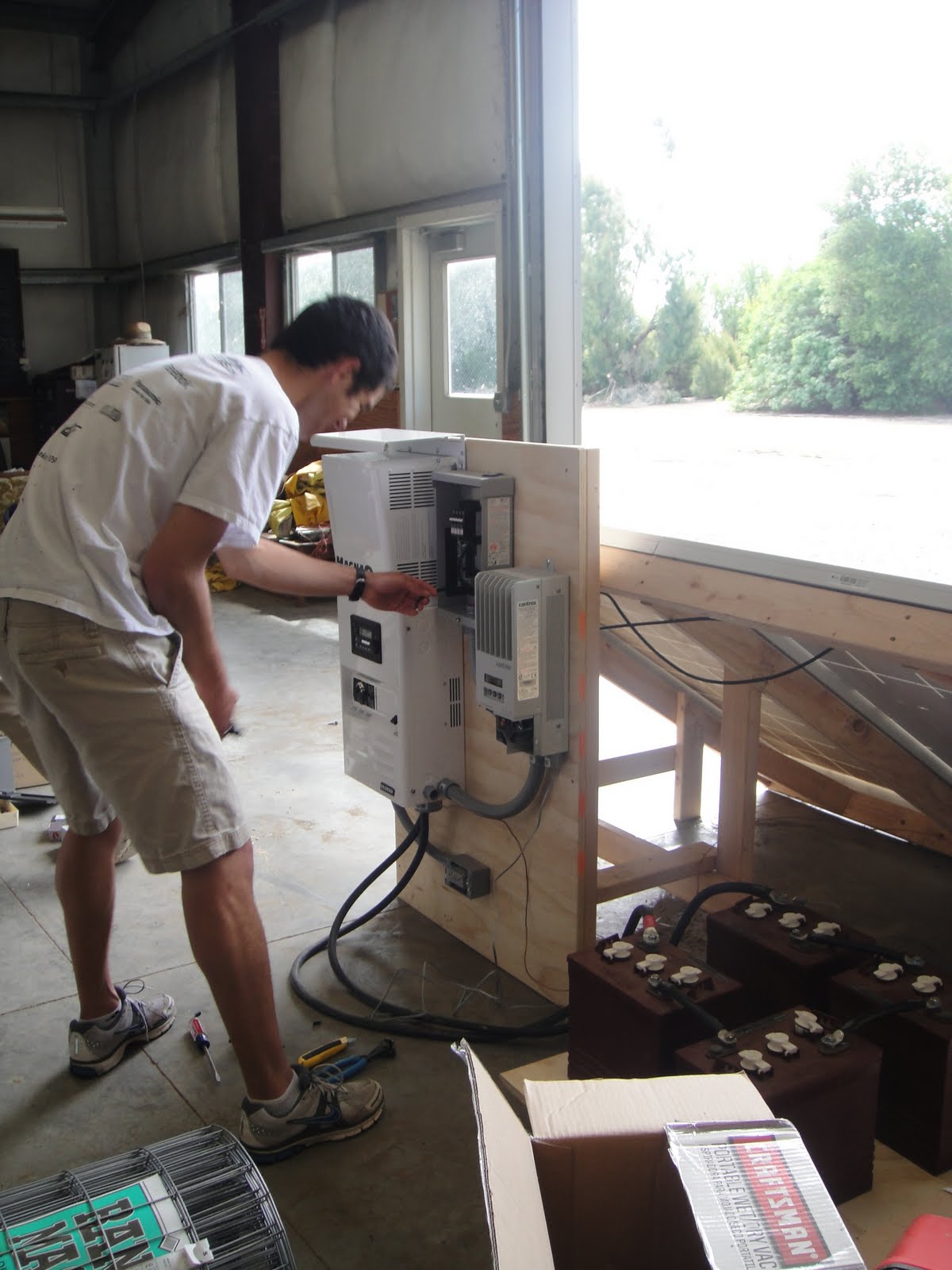
In collaboration with Horticulture Collaborative Research Support Program (Hort CRSP), the D-Lab CoolBot group set about assembling a model standalone photovoltaic array in order to power the demonstrative CoolBot Coolroom at the UC Davis Student Farm.


Ariana and Mike assembling solar
 array with faculty collaborator
The array consists of the following: four 220 volt solar panels, four wooden frames built by Dr. Michael Reid, four 6 volt deep cycle batteries in series, and a control board. The control board, that is, a breaker panel and charge controller, an inverter and a plug outlet to the AC load (the air conditioner and CoolBot) was assembled by Dr. Reid and Ariana Rundquist on April 15th.


CoolBot group installs
solar array
Ariana, Sheeter and Mike all helped assemble and successfully connect the photovoltaic array to the CoolBot Coolroom on April 18th and 19th, just in time for a visit from the touring Hort CRSP conference!


-- 
Ariana Rundquist, D-Lab Student 
International Agricultural Development 
Graduate Group
University of California in Davis

Tuesday, May 10, 2011

CoolBot Coolrooms: D-Lab Demo Site in Uganda

Anikua's pigeon peas from her
garden in Pajulu, Uganda
Refrigeration is key to the successful marketing of perishable items. The fresh produce and floriculture industries of the developing world depend on low temperatures to reduce water loss, slow the development and incidence of postharvest diseases, and limit responses to ethylene and other metabolic changes which reduce shelf-life.
Anikua's cabbage in Pajulu, Uganda
Temperature control is even more critical for the production of fresh produce in the developing world, where ambient temperatures often are above 30°C, resulting in deterioration rates more than 20 times those at 0°C (the proper storage temperature for many high value horticultural crops).
Quality can quickly decrease in fresh fruits and vegetables once they are harvested. If not carefully handled and stored properly then nutrient content is reduced along with shelf-life, or how long the product lasts before becoming inedible.  

Building storage "cooling" room
in Pajulu, Uganda
Economically, as much as 40-70% of fresh product is lost in the developing world due to post-harvest issues such as physical damage, disease, and improper handling. Temperature management is a key tool for reducing such loss of perishable food crops and maintaining nutritive quality.

However very few smallholder farmers have access to cooling or cool storage facilities, and even refrigerated transportation is a rarity. For resource-limited farmers in the developing world, cool-rooms and transportation systems employing mechanical refrigeration are economically and practically infeasible.

Demo of CoolBot System
In February 2010, the Horticulture Collaborative Research and Support Program (Hort CRSP) funded several “Pilot Projects” towards "reducing poverty, improving nutrition and health, and improving sustainability and profitability through horticulture." One of these one-year, ready to implement, and innovative projects to be tested in developing nations was the CoolBot Coolroom system. This system uses a well-insulated room and an intelligent thermostat device called the “CoolBot” (Store it Cold Ltd.) controlling a standard, wall-mounted air conditioning unit, tin order to create cheap and effective cold storage for small-scale, resource-poor farmers.

D-Lab student Ariana Rundquist
opens Coolbot storage room
Michael Reid, professor emeritus at UC Davis (UCD) University, is one of two Principle Investigators working from UCD with in-country collaborators in India, Honduras, and Uganda. Reach Your Destiny Consult was the on-the-ground partner in Uganda, and the in-country Principle Investigator (the representative from Reach Your Destiny Consult) is Gloria Androa, a former International Agricultural Development (IAD) graduate student at UCD. Ariana Rundquist, a current IAD graduate student and a D-lab student, was recruited as a Research Assistant for the project. These three members approached the D-lab at UC Davis in the Fall of 2010, hoping for an economic feasibility assessment of the implementation of the CoolBot Coolroom System in a small village of Arua District, Uganda.

Wrapping heater for temp
sensor of AC unit
Here are pictures of two demonstrative CoolBot Coolrooms, one built in 2010 here at the UCD student farm and one built in 2011 at Yabiavoko village, Ombokoro Parish in Manibe Sub-County, Arua district. 6 km from Arua town, which is 540 km from Kampala city.

--
Ariana Rundquist, D-Lab Student, International Agricultural Development Graduate Group
University of California in Davis

Demonstration coolroom awaiting insulation and roof in Uganda


Friday, February 18, 2011

Scrap metal + Recycled motor oil + Sandbox = Machine parts for sustainable energy technologies in Guatemala

At XelaTeco, an affiliate of the Guatemalan NGO where I'm working on a D-Lab project, an "appropriate technology" process is used for casting metal machine parts. Used motor oil, much cheaper than propane or other potential fuels, flows down a hose to fire up a foundry, where scrap metal is melted. The machine part to be cast is pressed into a box of sand and removed to leave an impression. The molten metal is then poured into the mold, creating an exact replica of the original machine part. Though not the cleanest process, this particular sand casting method makes use of motor oil that would otherwise be discarded. XelaTeco uses the process to make parts for micro-hydroelectric turbines, one of the sustainable energy technologies it's promoting, and for other commissioned machinery.

The whole set-up: the black barrel of motor oil is elevated on the empty green barrel to create pressure for the oil flow. A fan between the barrel and crucible chamber creates a convection effect to increase the heat in the chamber.


The crucible where the aluminum will be melted.


Scrap aluminum is cut with a hacksaw into pieces that will fit into the crucible. Any rubber or plastic is removed.

The machine part to be duplicated is pressed into barely moistened sand in a wooden box. Once the sand is well compressed, the piece is removed and the impression remains.


The process is repeated with the top half of the sandbox, but in this case plastic pieces (sawn off legs of a bed frame!) are used to create holes into which the molten metal will be poured. Due to their conical shape, they are easily tapped out with a hammer, leaving channels in the sand.


The aluminum is heated in the foundry to a temperature of about 1300° F.


The red hot crucible is carefully lifted from the foundry.


Debris and contaminants are skimmed from the surface of the molten metal.


The aluminum is carefully poured into the holes left by the bed frame legs.


Once the metal starts to overflow out of the holes, the pouring is stopped.


15 minutes later, the box and sand are removed, leaving the cast piece, which will need much sawing and grinding.

Pieces for a micro-hydroelectric turbine, cast in bronze using the same process.


 Here's a video of part of the casting process.

-Larisa Jacobson, D-Lab I and II alum, M.S. candidate in International Agricultural Development

Off-Grid Lighting Project in the Niger Delta -- from the field


The Niger Delta is an intense place. We had a short but busy trip to Bayelsa State, where we met with a new local partner, Niger Delta Wetlands Center (NDWC).  NDWC is a long-running local NGO that works on environmental conservation and community development projects in the area. They’re well-managed, and with successful projects under their belt, they have street cred, which seems to be rare in the delta.

The objectives of the trip were to meet with NDWC and other project partners, and be introduced to a community they are working in, called Aduku. The other partners represented were VDI Group and International Institute for Environment and Development, both of whom have long experience in Nigeria.

The format of the visit was an inclusive, 4-day workshop that was attended by all the project partners as well as members of Aduku and other local communities. Miriam, the head of NDWC, organized a great group and the whole proceeding was very participatory in nature—the community members and NGO representatives took turns presenting and discussing various issues around energy, lighting, water, and social development in the community.

Kurt Kornbluth, Director of D-Lab, gave a few different presentations, talking about the D-Lab approach and how we assess project feasibility through the “4 lenses of sustainability.” We also did some hands-on workshops with the groups, walking them through a basic lighting/electricity lab where they learned how to calculate loads, read generators, etc. and also an off-grid lighting demonstration, where we showed different solar lantern products and discussed the various features and costs of each design. We learned a lot about the challenges of working in the delta, and the huge number of (usually nontechnical) barriers NDWC faces in its projects. We trained NDWC staff on some of the concepts of focus groups, and then let them practice running focus groups around the lighting products. Good fun, and lots of mutual learning.

The community Aduku was interesting in a few ways. Situated far from the electricity grid and alongside a creek near the River Forcados, the whole village is strung along the waterway in a thin row of houses. Almost all houses are stick and mud with corrugated metal roofs. Most residents are subsistence farmers and fishermen, with some timber and gari (cassava meal) processing as well. One unexpected finding was that a large number of households own and run small (<1kW) generators, which they use to power TVs, fans, fridges, and lights. Even though fuel is subsidized and costs only US$0.50/liter at the pump, some of these households end up paying more than N2000/week in fuel, or about US$13.   

Obviously these households are not in the lowest income group, but the amount spent on fuel and generators was still surprising if you compare it to someplace like Zambia. Of course, culture is a big driver, and apparently there are some strong social status implications with owning and running a generator—witness the colloquial name for these small generators: “Pass My Neighbor.” So you can imagine that in an area where a fossil-fuel based generator is a primary symbol of a household’s movement up the socioeconomic ladder, there will be some challenges introducing a solar-powered alternative.

Bryan Pon, D-Lab Graduate Student Researcher, PhD Candidate, Geography

In the Field: Flaming gas or a lot of hot air? Complications of deforestation, firewood, and household biodigesters in rural Guatemala

Larisa here, in the field for D-Lab in Guatemala (see this earlier post for background on the project). A month of long days, sweat, and pig manure has meant few blog posts! Though by now we´ve completed the biodigester installations (more on that in a bit), we first visited La Felicidad to meet with the five families purchasing the pilot biodigesters, and to learn more about their household energy use, cooking habits, farming and animal raising practices, and more before the installations.

Setting off in a pickup truck from Xela, our ears popped as we wound down more than 7,000 feet into the coastal region, past potato, onion, and cabbage farms, the land powdered white with the lime so commonly used here for its effects on soil nutrients and acidity. Once we reached sea level, we sped by endless coffee fincas and rubber plantations, their slashed trees dripping milky sap into black plastic cups.

Along the way, Guatemala’s struggle with deforestation, and the resulting erosion of already steep slopes, was evident.

Population growth, clearing of land largely for subsistence agriculture, and cutting of trees for firewood have all played a part: in the past twenty years, Guatemala has lost 23% of its forest cover, or nearly 134,800 acres (that’s 102,121 football fields, including the end zones), according to the Food and Agriculture Organization of the United Nations. A Zeno’s Paradox of farmable land—precarious land tenure, the land distribution legacies of colonialism, discrimination against indigenous peoples, and high birth rates force parents to divide up the little property they have among multiple children—means that cleared land, however depleted the soil, is a valuable commodity.
Land to be planted next season

Factor into this that 95% of tree-felling in Guatemala is carried out illegally by those in need of fuel and/or income, and that unstable eroded soils not only make farming more difficult but can lead to life and home threatening mudslides (the UN ranks Guatemala fourth in the world for risk of death from mudslides), and you have a very complicated problem knit tight into daily life by a web of constraints and trade-offs.

As in much of the world, the simple acts of cooking and getting food on the table each day require large amounts of fuel, labor, and time. Worldwide, two-thirds of people in developing countries cook or heat their homes with biomass fuel—wood, dung, crop residues, or charcoal. In Guatemala, estimates vary, but it’s believed that 60 to 80% of families cook with firewood.

In addition to the environmental effects, there are the health risks associated with burning so much solid fuel. According to the World Health organization, indoor air pollution contributes to more deaths worldwide—an estimated 1.6 million from cases of pneumonia, chronic respiratory disease, and lung cancer considered “strongly associated” with the pollution—than malaria each year. Women and children are most affected, and the lower a family´s income, the more likely it is to depend on such energy intensive practices on a daily basis.

And finally, buying large quantities of firewood can strain families’ limited resources. In La Felicidad, a typical family spends 2000-5000 Quetzales (around $250 to $650) on firewood per year—a lot for those who depend largely on subsistence farming and whose little income may come from selling a few animals each year and working seasonally on the nearby coffee and rubber fincas. To reduce costs, some families spend hours each week gathering wood.

Convincing arguments for cooking with biogas, right? Beside the initial cost of the biodigester (offset in a year or two in saved firewood costs) and the 15 or so minutes of labor required each day to gather manure and feed the digester, there are few to no costs, the methane gas burns cleanly without smoke, and the process produces an organic fertilizer that can be used in the fields, in some cases replacing costly chemical fertilizers.

I’ve emphasized statistics in this post for a reason. But I can tell you that in rural Guatemala, many of these don’t mean bunk. Life here, as in many places in the world, is rarely decided in response to compelling statistics, or even promises of financial savings on the scale of a year or health benefits over a lifetime. What is compelling is the day-by-day of getting by, and doing things in a way that makes sense to the people doing them.

Take Doña Gloria, who we visited in La Felicidad. Her outdoor cooking area, or polletón, is essentially an open fire—a few iron slats laid across burning wood. Though not as smoky as enclosed kitchens (where it’s estimated that cooking with an open fire is the equivalent of smoking two to five packs of cigarettes a day) polletóns are often in semi-enclosed wood shelters, and the woman stands directly over the fire as she cooks.
A typical outdoor kitchen

A polletón

Cooking a pot of beans takes 3 hours and lots of wood and smoke

In recent years, NGOs and government institutions such as Guatemala’s Social Investment Fund (FIS) have promoted the installation of planchas, improved stoves with a metal surface into which different sized pots can fit, chimneys to decrease smoke in the kitchen, and in some cases specially modified combustion chambers to increase fuel use efficiency and reduce firewood consumption by 50 to 70%.
A plancha with chimney and cooking surface with removable concentric circles for pots

But… Doña Gloria already has one of the improved stoves. She only uses it during the rainy season, when the wet and wind make her outdoor wood fire impractical. In the dry season, the plancha makes the kitchen too hot and stuffy, so she prefers to cook outside and use her indoor kitchen for organizing the items she sells in her small tienda (store). In other homes, the plancha is used more like a highly accessible shelf for pots and pans than a highly efficient stove. From the colorful plastic containers littering the surface, you can see the planchas aren’t used regularly.

As for the toll that deforestation takes, with a few exceptions, trees are prized not for carbon credits and “ecosystem services,” but are appreciated for the fuel and the shade they provide, especially in this region of blazing sun. Likewise, the smoke from the open fires is valued as a powerful mosquito repellent. And besides—as I can attest from the lunches of stew and tortillas that have been generously given to us when we work in La Felicidad—cooking the food over a fire gives it a lovely, smoky taste, one that people are fond of and used to.

Another issue is the task of collecting manure to feed the biodigester daily: here, most families’ pigs are not enclosed, but run free in the streets during the day, pooping where it pleases them, only returning at night to their corralito. Often, as we left La Felicidad in the evening, we would see the pigs dutifully trotting home for dinner. There's plenty of manure around, but would people want to take the time to collect it?

So, in her outdoor kitchen in La Felicidad, Doña Gloria wasn’t buying it. Without consulting her, her husband had agreed with the community leader (who wants the biodigesters in the community for the financial savings they should bring and for their possible draw as a ecological demonstration site) that their family would be buying a biodigester that cost more than a month’s income. This was Doña Gloria’s first time hearing about making cooking gas from manure, and for all she knew, we were selling snake oil. She was also worried about whether the biodigester would bring odors and flies, and about the surface of her tile counter (she was assured that it would not be harmed). She shot her husband a sideways look much like my grandmother used to give my grandfather when he was trying to make himself “useful” in the kitchen, conveying without words a dubious combination of “Give me a break…” “What have you done?,” and a resigned “Ay, Dios mio…” As we asked her and her husband the questions for the baseline survey, her doubt was palpable.

In another family, the father, who surprisingly had heard of biodigesters before, was fascinated by the technology but also concerned about the cost and whether the investment would pay off. Again, his wife was skeptical. Since it’s the women who will cook with the gas, it’s crucial that they be on board and included, and they obviously hadn’t been in the decision-making process to date. All of which has interesting implications for future efforts to create a Guatemalan biodigester company.

In the end, Doña Gloria and husband decided to wait a few weeks for their installation, while the other family decided to go ahead right away. Would the first biogas produced calm the families’ doubts, or would they continue to fear that we ourselves were full of cow manure? More about the installations in posts to come.
-Larisa Jacobson, D-Lab I and II alum, M.S. candidate in International Agricultural Development